
Skip to content
KNIME Documentation
Main Navigation Get startedBuildWork with KnimeAccount and adminRelease notesDeveloper tools
Community Hub
DevelopersKnime 2.0
Sidebar Navigation

Getting Started

Installation

User Guide

Release Notes

Install Extensions

Building Workflows

Components

Flow Control

Expressions

File Handling

Deployment

Integrated Deployment

Workflow Invocation

Best Practices

Advanced Features

AI Extension

Get Started

Build an Agent

Inject context with RAG

LLM Providers

Tutorials

Summarize product reviews

Product FAQ assistant

Restaurant agent

Your first local agent

Task extractor

Reporting

Kerberos

Extensions

Database

Overview

Tutorials

Read and filter data from a database

Write a transformed dataset to a database

Concepts

Ports and Sessions

Query Generation

Type Mapping

Deprecated Framework

Connecting

Connect: Dedicated Node

Connect: File-Based Database

Connect: Generic DB Connector

Register a JDBC Driver

Install Third-Party Driver Plug-in

Drivers on Hub and Server

Kerberos Constrained Delegation

Reading and Transforming

Read Data

Transform Data Visually

Run a Custom SQL Query

Parameterize a Query

Writing and Modifying

Insert, Update, or Merge

Delete Rows

Bulk Load Data

Create and Remove Tables

Use Transactions

Reference

Connector Node Settings

JDBC Driver Reference

Deprecated Node Mapping

Migrate Deprecated Workflows

Python

Overview

Tutorials

Python Scripting Quickstart

Data App Development Using Plotly

Data Processing

K-AI Scripting Assistant

Data Type Conversion

Batch Processing

Jupyter Integration

Environment Management

Pixi Configuration

Dependency Management

Environment Persistence

Channel Mirrors & Air-Gapped Setups

Conda Migration

Alternative Configurations

Conda and Miniforge Setup

Conda Environment Propagation

Manual Python Configuration

Legacy Node Migration

Concepts

Pixi Backend Architecture

Storage Logic

Python Environments on Executors

Reference

Python Scripting API

Bundled Packages

Executor and Hub Configuration

Troubleshooting Guide

API Reference

Inputs and outputs

Classes

Views

Utility functions

R

Deep Learning

Snowflake

Google Cloud

Azure

AWS

Big Data

Big Data Admin

Big Data Secured Cluster

Databricks

Microsoft Fabric

Power BI

Tableau

Report Designer

H2O

Changelogs

Version 5.12

Version 5.11

Version 5.10

Version 5.9

Version 5.8

Version 5.7

Version 5.6

Version 5.5

Version 5.3

Extensions

Manual Python Executable / Start Script ​

If you do not use Conda or Pixi, you can point KNIME Analytics Platform to any Python executable or shell/batch start script.

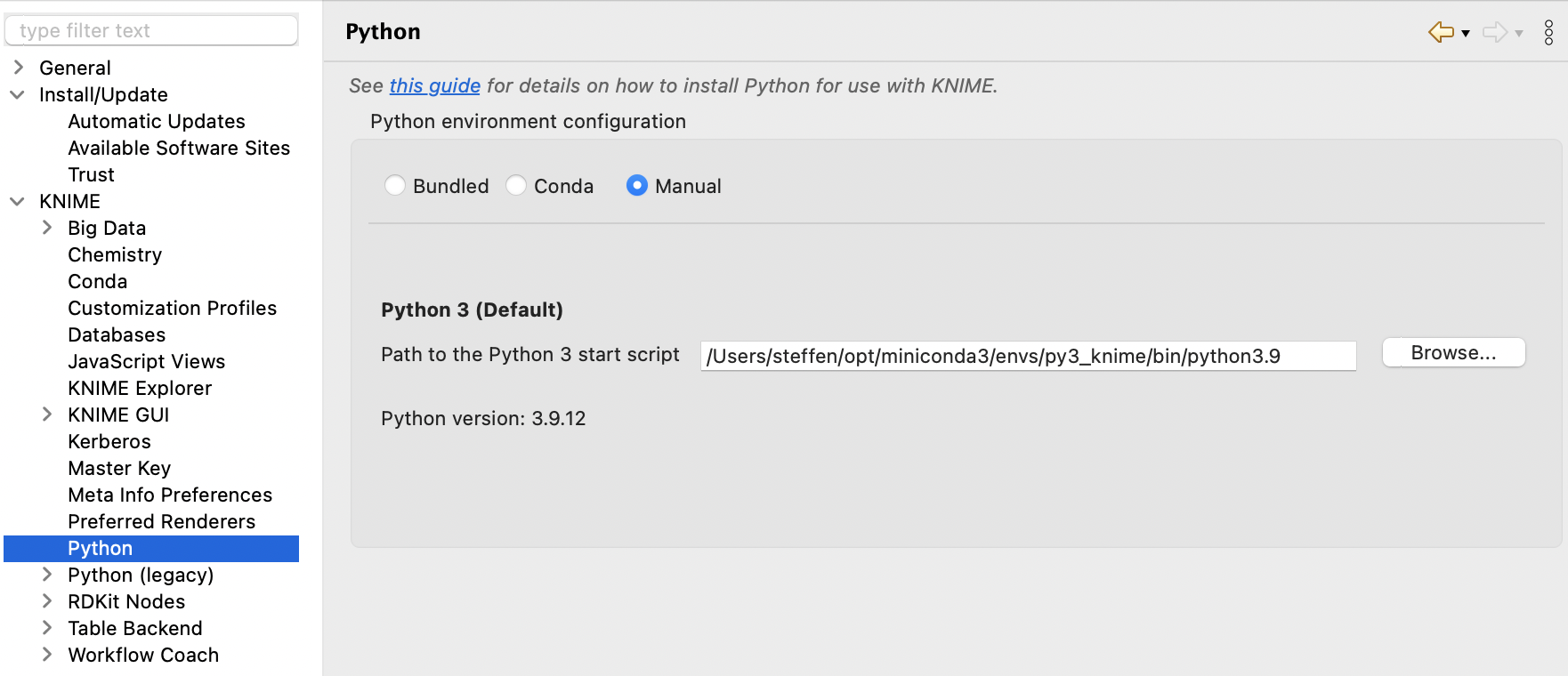
Via the Preferences page (AP-wide) ​

  1. Go to File → Preferences → KNIME → Python.
  2. Choose Manual.
  3. Point KNIME to either:
    • A Python executable directly.
    • A start script that activates an environment and launches Python.
Start script requirements ​

The script must:

  • Start Python with the arguments passed to the script (escape spaces correctly).
  • Forward standard output and standard error from the Python process.
  • Not output anything else.

Linux / macOS example ​

bash
#!/bin/bash
export PATH="<PATH_TO_ANACONDA>/bin:$PATH"
conda activate <ENVIRONMENT_NAME>
python "$@" 1>&1 2>&2

Make the script executable: chmod gou+x py3.sh

Windows example ​

batch
@REM Adapt the folder in the PATH to your system
@SET PATH=<PATH_TO_ANACONDA>\Scripts;%PATH%
@CALL activate <ENVIRONMENT_NAME> || ECHO Activating python environment failed
@python %*

INFO

These examples use Conda commands. Replace the Conda-specific parts if you use a different environment manager (e.g. venv, pyenv).

Via flow variable (per-node) ​

You can also configure individual Python nodes to use a specific executable or start script by setting the flow variable python3_command under the Flow Variables tab in the node's configuration dialog. The variable accepts the same path to a Python start script as described above.

Next steps ​

  • Set up Pixi (recommended)
  • Set up Conda / Miniforge
  • Persist environment in Preferences
Pager
Previous pageConda Environment Propagation
Next pageLegacy Node Migration