
Type mapping
Different databases support different sets of data types. Type mapping lets you define rules that control how database types convert to KNIME types and how KNIME types convert to database types.
Why it matters
Databases handle types inconsistently. Oracle, for example, uses a single numeric type with varying precision to represent both integers and floating-point numbers, while KNIME uses distinct types (integer, long, double). Date and time handling is especially inconsistent: the KNIME Date&time (Zoned) type — which represents a point in time within a defined time zone — is supported by only a few databases.
Without type mapping rules, KNIME uses the default mapping for the connected database. With explicit rules, you can override these defaults — for instance, forcing KNIME to write Date&time (Zoned) values as strings, and to read them back as Date&time (Zoned) on ingestion.
How it works
The type mapping framework defines rules in two directions, from the KNIME perspective:
- Output Type Mapping: maps KNIME types to database types (used when writing data to the database).
- Input Type Mapping: maps database types to KNIME types (used when reading data from the database).
Each direction supports two rule sets:
- Mapping by name: applies to columns that match a specific name or regular expression, combined with a type condition.
- Mapping by type: applies to all columns of a given KNIME or database type, regardless of name.
Where to configure type mapping
Type mapping rules are part of the DB Connection and DB Data connections and are inherited by downstream nodes.
- Connector nodes: provide a sensible database-specific default mapping. Configure the baseline here.
- DB nodes with KNIME table input (for example, DB Writer): include an Output Type Mapping tab to override how input KNIME column types map to database column types for that specific node.
- DB Type Mapper node: changes the database-to-KNIME mapping for all downstream nodes on a DB Data connection.
DB Type Mapper
The DB Type Mapper node modifies the Input Type Mapping configuration for subsequent nodes. Use it to change how the database type of a specific column is interpreted in KNIME.
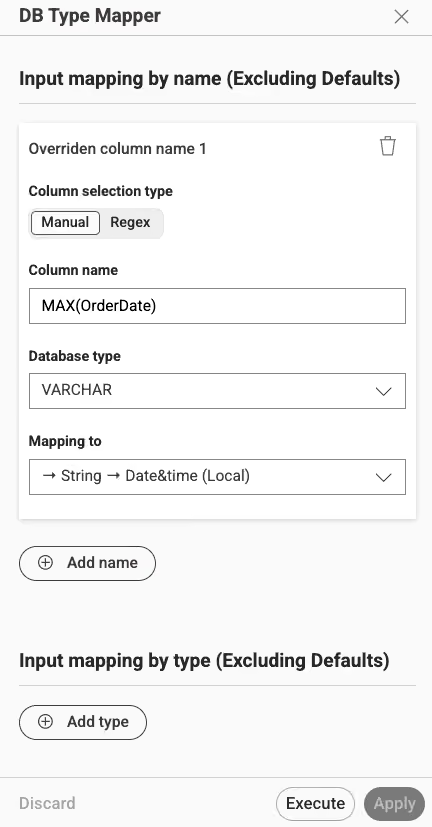
New or modified rules appear in bold. Rules inherited from upstream nodes cannot be deleted — only modified.
Key concepts
- Output Type Mapping: KNIME → database. Applies when writing.
- Input Type Mapping: database → KNIME. Applies when reading.
- Mapping by name: targets a column by name pattern and type.
- Mapping by type: targets all columns of a given type.
- Name-based rules take precedence over type-based rules when both match.